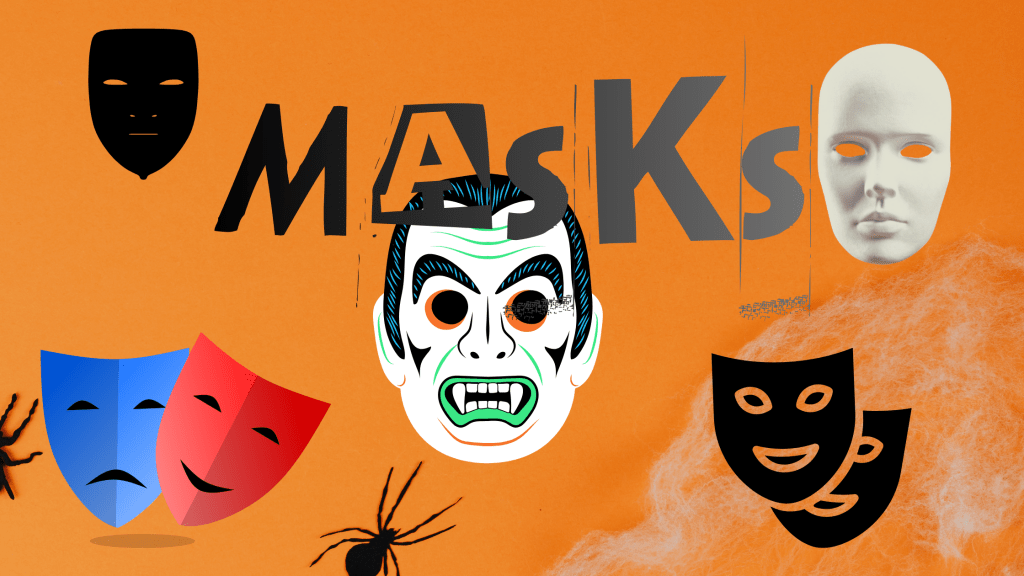
The Blog of Masks
October crept in with a chill that wasn’t just in the air. It was in the atmosphere. The kind that makes you think about what you show, what you hide, and what lingers underneath it all. Maybe it’s the Halloween of it, or maybe it’s something deeper. Either way, this month asked me to think about masks. Not the kind made of cloth or plastic, but the kind we wear without realizing it.
We all wear them, don’t we? The “I’m fine” mask. The “I’ve got it together” mask. The “don’t worry about me, I’m strong” mask.
They start out as small protections. Tiny performances to make the world easier to face. However, if you wear them for too long, they stop being costumes and start becoming a part of your skin. That’s what I wanted to explore this month with my story at the end of this blog. It’s a horror story on the surface, but underneath, it’s about something hauntingly human: what happens when we lose ourselves trying to please everyone else.
According to Merriam-Webster, a mask is “a covering for the face used for disguise or protection.” And that definition says it all. Disguise or protection. Sometimes both.
We use masks to hide our pain, to shield our vulnerability, and to curate how others perceive us. They make us feel safe, seen, or sometimes invisible, depending on what we need at the time. But like any good disguise, the danger lies in forgetting there’s a real face underneath.
This month, I’ve been thinking a lot about my own masks. The parts of me that shift depending on where I am or who I’m with. The teacher mask. The artist mask. The “I’m fine” mask when I’m not. There’s a strange comfort in them: they help us survive, adapt, and connect. But they can also silence us. They can make us forget that authenticity isn’t a performance, it’s a practice.
And that practice takes courage. Because taking off a mask isn’t as simple as removing it. Sometimes, it’s peeling it. Layer by layer. Sometimes, it’s realizing you’ve worn it so long that your reflection looks wrong without it. Sometimes, it’s looking in the mirror and not knowing who’s underneath. But here’s the truth I’m holding onto this October: Your real face, the one that’s messy, tired, unsure, imperfect, is worth showing.
Even when it feels risky. Even when the world prefers the mask. In my story for the month, “Losing Face,” Maya, the protagonist, learns that hiding behind versions of herself only leads to disappearance. It’s a chilling metaphor, but it’s also a mirror for so many of us. We think we’re protecting ourselves by performing, but over time, we erode our own edges. This month reminded me how important it is to check in with myself and ask: Am I being real, or am I just being who I think they want me to be?
The great poet Oscar Wilde once said,
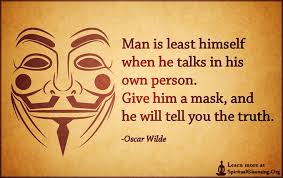
Maybe he was right in a way. That masks can reveal things that honesty alone can’t. But they can also hide us from the people who deserve to see us most. As October fades and the masks of Halloween get boxed away, I’m trying to take that metaphor to heart. To practice showing up as myself always. To let my real face be enough, even when it feels vulnerable. Especially then. Because the scariest thing about masks isn’t putting them on. It’s forgetting to take them off.
Story of the Month
by me
Losing Face
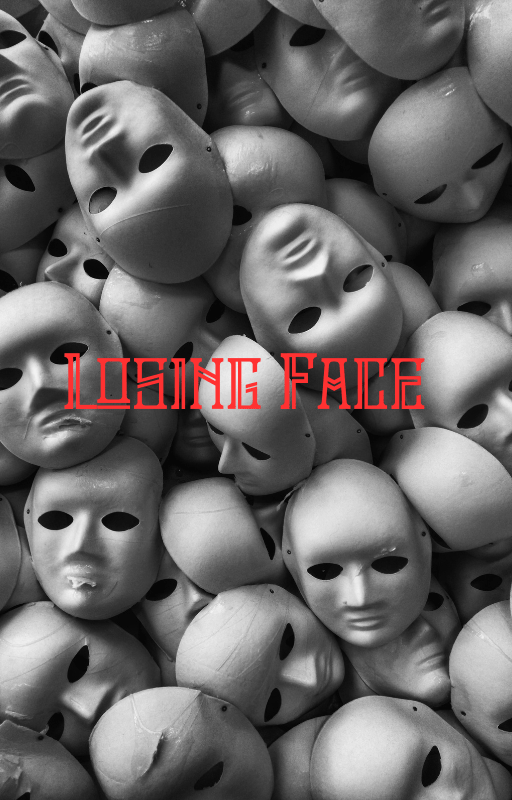
The mirror knows what Maya tries to hide—
That girl who shifts like water, side to side,
Who shapes herself to fit each watching eye,
Who wears a different face for every lie.
She stood before her glass that Friday eve,
And counted all the masks she’d learned to
weave:
The smile that made her mother sigh relief,
The laugh that buried all her secret grief,
The girl who never cracked, who never bent,
The perfect, pretty, polished one they meant
To see when Maya walked into a room.
She tried them on like choosing her costume
—
First one, then two, then three stacked on her
face,
Each mask a different role, a different place
She’d learned to occupy when people
watched.
And underneath them all, her real self:
botched,
Forgotten, buried deep beneath the weight
Of all these faces she’d learned to create.
Which one tonight? she wondered, standing
there.
But as she reached to smooth her tangled
hair,
Her fingers brushed her cheek and felt—not
skin—
But smoothness, coldness, something hard
and thin.
She looked again and felt her stomach drop.
Her face—her actual face—had seemed to
stop
Existing. In its place: a blank of white,
A smooth expanse like snow, like bone, like
fright
Made manifest in porcelain and air.
She clawed at it, but nothing waited there—
No seam, no edge, no place where mask
would end
And Maya’s face begin. They couldn’t blend
Because her face was gone. Just—gone.
Erased.
The blankness where her features had been
placed
Stared back at her: no eyes, no nose, no
mouth,
Just white, white, white, expanding north to
south.
She tried to scream but had no mouth to
scream with.
Tried to cry but had no eyes to dream with.
Tried to breathe but—could she? Was she
breathing?
She couldn’t tell. Her whole self felt like
leaving,
Slipping through her fingers, through the
floor,
Dissolving into nothing anymore.
Her phone buzzed on the dresser. Twenty
texts.
From Jordan: Where are you? We’re all
preplexed.
From Alex: Party’s starting, please don’t
flake!
From Mom, downstairs: Are you okay, for
heaven’s sake?
And standing there, faceless, voiceless, gone,
Maya understood what she had done—
The years of being different for each friend,
Of twisting, changing, shifting, making her
blend
Into whatever shape they needed most.
She’d worn so many faces like a ghost
Wears different sheets, that underneath the
masks
There was no face at all to do the tasks
Of being Maya, being real, being true.
She’d given all her faces out to you—
To Jordan, Alex, Mom, to teachers, strangers,
Boys she’d kissed, to friends and all the
dangers
That came from wanting desperately to
please,
From bending herself into what would ease
Their comfort, their approval, their demand
—
Until her real face couldn’t understand
How to exist when no one else was watching.
And so it left. Her face. It went. Now mocking
Her from the void where faces go to die
When worn too thin by every different lie.
She stumbled down the stairs, the house a
blur
Of walls and sounds that didn’t comfort her.
Her mother stood there, spatula in hand,
And looked at Maya—tried to understand
The thing before her: daughter-shaped but
wrong,
A body with no face, nothing to belong
To any name or category known.
Her mother screamed. The sound cut to the
bone—
Or would have, if Maya had bones to feel.
But was she Maya still? Was she real?
Without a face to call her own, to mark
Her as distinct, unique, not just some dark
And formless nothing wearing Maya’s
clothes?
Her mother backed away. The kitchen froze
Around them both—time-stopping, breaking,
caught
Between the girl her mother knew and
thought
She’d raised, and this blank creature,
faceless, strange.
Mom, it’s me! she tried to say. No change
Occurred. No sound emerged. No voice
existed
Where her mouth had been. She’d been
enlisted
In an army of the lost, the disappeared,
The girls who wore so many masks they’ve
smeared
Away their real selves underneath the
weight.
Her mother called the police. “Please, don’t be
late,
There’s something in my house, it’s not my
daughter,
It’s—I don’t know—please send someone—”
The water
In Maya’s eyes—except she had no eyes—
Felt hot and thick. A sob without the cries.
Her mother couldn’t see her anymore.
She’d worn too many masks and now the
door
To her real self had closed, had locked, had
sealed
Her out. Her face would not be revealed
Because she’d given it away in pieces,
A little bit to each friend, until it ceases
To be whole, to be hers, to exist at all.
She ran—or did the faceless run or fall?
She moved through streets like wind, like
smoke, like fear,
And everywhere she went, people would
veer
Away from her, would scream or gasp or stare
At the blank horror of her face, the bare
Nothingness where Maya used to be.
At Jordan’s house the party raged with glee
—
Costumes and music, laughter, dancing, light.
Maya stood outside, alone, the night
Pressing around her like a living thing.
She watched through windows, saw them all:
the ring
Of friends she’d built by being who they
wanted,
By suppressing what her own heart haunted,
By swallowing her truths and speaking
theirs.
She saw the girl—was that Samira?—wearing
A mask that looked familiar: Maya’s smile,
The one she used with athletes. And
meanwhile,
Jordan wore a diffrent Maya mask—
The party girl, the wild one. Every task
Maya’d done, each role that she had played,
Was being worn by others, a parade
Of Maya faces that were not her own
Because she’d given them away. She’d sown
Her face in pieces across all her friends
Until there was no Maya. It ends
Like this: a faceless girl outside a party
Where everyone’s wearing the face she used
to be.
She pressed her hands—at least she still had
those—
Against the window glass. In rows and rows,
The party-goers danced with Maya’s faces,
Each one performing, filling in the spaces
She’d occupied with carefully crafted lies.
And none of them could see her. No surprise.
How could they recognize her when they’d
never
Seen her real face? She’d been so clever,
So careful to show each of them a version
Of herself they’d like—a careful immersion
In whoever they needed her to be.
But who was Maya when there was no
“they”?
Who was she when no one watched or
waited?
Who was she before she’d abdicated
Her own face for the faces she could wear?
She couldn’t remember. Standing there,
Faceless, voiceless, disappearing fast,
She tried to reach back to her past
And find a moment when she’d just been her
—
Not performing, not trying to defer
To someone else’s comfort or desire,
Not dampening her own internal fire
To make room for the people around her.
But every memory felt like a blur
Of different Mayas, none of them quite true.
The girl who laughed too loud. The girl who
knew
To stay quiet. The girl who played dumb.
The girl who acted smart. They’d all become
So tangled up together that she’d lost
The thread of who she was beneath the cost
Of being everything to everyone.
And now her face—her real face—was gone.
Erased. Deleted. Lost to the void
Of all the masks she’d carefully deployed.
The glass beneath her hands began to crack.
Not breaking, but responding—fighting back
Against the weight of what stood pressing
there:
A girl-shaped nothing, empty, blank, unfair
In its erasure, in its warning, in
Its horrible reminder that your skin,
Your face, your self—they’re not infinite
resources
To be divided up. There are courses
Of consequence for giving yourself away
In pieces, bit by bit, day after day,
Until there’s nothing left that’s yours alone.
The window shattered. Maya stood,
unknown
And unknowable, in Jordan’s living room.
The music stopped. The party met its doom
As everyone turned, stared, began to scream
At the faceless figure from a nightmare
dream.
Jordan ripped off Maya’s borrowed face—
The mask she’d worn—and it fell into place
On Maya’s blank expanse. But it didn’t stick.
It slid right off, like oil, slippery, slick,
Because it wasn’t hers. It was a copy,
A performance, a mask, and masks are sloppy
Imitations of the truth beneath.
Maya felt something rising like a wreath
Of thorns around her throat—a desperate
sound,
A wordless howl of grief for what she’d
drowned
In years of people-pleasing, of performing.
Of waking every day and transforming
Into whoever everyone else needed,
Until her own needs went completely
unheeded
Even by herself. Especially by herself.
The sound that came was unlike anything
else—
A shriek, a wail, a cry of pure despair
That had no mouth to shape it, only air
And anguish, emptiness and loss and rage
At what she’d done, at what the final page
Of her story might be: a blank space,
A cautionary tale of losing face.
The party guests fled screaming out the door.
But Jordan stayed—perhaps she’d seen
before
The signs that Maya’d struggled, maybe
knew
The weight her friend had carried, pushed on
through.
She picked up all the Maya masks that lay
Scattered on the floor, the ones they’d played
At being, and she held them to the light.
“Is this what you’ve been doing? Every night,
Every day, with all of us? Pretending?
Maya, this” — She gestured to the bending,
Breaking girl-shape standing blank before
her.
“This is what happens when you ignore her—
When you ignore yourself. You’ve given us
So many faces, made such a fuss
About being what we wanted, that you’ve
lost
Your real face. Maya, what’s the cost
Been like? Carrying all these different
versions?
Playing all these roles, these immersions
In whoever we needed you to be?”
The faceless Maya sank down to her knee,
Then both knees, then collapsed there on the
floor,
And Jordan sat beside her. “I wish you’d told
me more.
I wish I’d seen you—really seen you. Not
The masks. But I was comfortable with what
You showed me. It was easy. It was nice.
I didn’t ask for more. I didn’t think the price
You paid was this. I’m sorry, Maya. I’m
So sorry.” Jordan cried, and for a time
They sat there in the wreckage of the party,
Surrounded by the masks—the false, the
artsy,
The carefully constructed lies that Maya
Had worn until she’d made herself a player
With no true character, no solid core.
I don’t know how to be me anymore,
Maya tried to say. And this time, words—
Faint, fragile, quiet as the flight of birds—
Emerged from where her mouth should be. “I
lost
Myself. I gave away too much. The cost
Was everything. My face. My voice. My truth.
I spent so long performing since my youth
That I forgot that I was supposed to be
Someone underneath. There’s no more me.”
Jordan took her hand. “Then we’ll start from
scratch.
We’ll sit here, and you’ll tell me—try to catch
Whatever’s left of Maya, the real girl
Beneath the masks. Let her voice unfurl
Even if it’s small, even if it’s scared.
Tell me something true. Something you’ve
never shared
Because it didn’t fit the mask you wore
With me. Tell me something from your core.”
The faceless girl sat silent for a while.
Then, faint and small, without a mouth to
smile
Or lips to form the words, she spoke a truth:
“I’m tired. I’ve been tired since my youth.
Of smiling when I’m not happy. Of
pretending
That I’m fine when I’m not. Of bending
Myself into shapes I don’t fit. Of being
Strong when I’m breaking. Of freeing
Everyone else to be themselves while I
Stayed silent. Jordan, I don’t want to lie
Anymore. But I don’t know how to stop.
I don’t know who I am without the prop
Of all these masks, these faces, these
personas.
I’m scared that without them, I’m just a loner,
That nobody will like me if I’m real,
That my true self isn’t good enough to feel
Worthy of love or friendship or belonging.”
And as she spoke, she felt it—something
longing,
Something stirring in the blank expanse
Of where her face had been. A second
chance?
Or just the faintest outline, barely there,
Of features forming slowly in the air—
A hint of eyes, uncertain and afriad,
A shadow where a mouth might be,
half-made,
A sketch of nose, of cheeks, of chin, of brow.
“Keep going,” Jordan whispered. “Tell me now
More truths. Tell me things you’ve hidden,
buried,
Swallowed down because you were worried
They’d make you seem less perfect, less ideal.”
And Maya spoke. And speaking what was
real—
However small, however scared, however
Imperfect—seemed to tether her together,
To pull her back from the void she’d fallen in.
“I’m jealous sometimes. I’ve told lies. My skin
Breaks out and I feel ugly. I don’t always
Want to go to parties. Some days
I want to scream at my mother. I’m not sure
What I want to do with my life. The pure
Truth is I’m confused and I’m scared
And I’m lonely even when I’m surrounded.
I’ve dared
Myself to be perfect for so long
That I don’t know how to just be wrong.
Or messy, or imperfect, or just me.”
And with each truth, more of her face would
be
Restored—still faint, still fragile, barely there,
But forming, slowly, in the darkened air.
It took all night. It took confession, tears,
It took admitting all her secret fears,
Her doubts, her anger, all the parts she’d
hidden
To be acceptable, to seem unbidden
By darkness or complexity or pain.
And slowly, slowly, like the gentlest rain,
Her features came back, piece by trembling
piece—
Though changed, somehow. A if the release
Of truth had altered how her face would
form.
This face was softer, less concerned with
norm
And expectation. This face could frown
Or cry or show confusion, could be down
Without apology. This face was real.
And Maya touched it, tried to learn to feel
The angles of her cheekbones, her own nose,
The way her mouth curved, the way it chose
To sit when no one else was watching her.
“It’s strange,” she whispered. “I’m not even sure
This is what I looked like before. It feels
Different. New.” She ran her fingers, peels
Away the tears. “But it’s mine. It’s really mine.
Not borrowed, not performed. I think I’ll find
It’s harder, wearing just my own true face.
People won’t always like it. Some will chase
The other Mayas, the masks I used to wear.
But I can’t do that anymore. I swear
I’ll never wear a mask again. I’ll be
Uncomfortable. Imperfect. I’ll just be me.”
Jordan smiled. “You’ll lose some friends.
Maybe
Some of us can’t handle that. But maybe
Some of us have been waiting all along
For the real you. Maybe we were wrong
To let you hide. Maybe we should have asked
Why you kept your self so carefully
masked.”
The sun rose slowly over Jordan’s house,
And Maya stood before the mirror, doused
In morning light, and looked upon her face—
Her real face, earned back through truth and
grace,
Through painful honesty, through letting
down
The walls, the masks, the performance, the
renown
That came from being everything to all
This face was hers. And if some friends would
call
It strange, or diffrent, or too much, too real,
Then they weren’t friends who’d help her
heal.
She touched her cheek—warm skin, real skin,
no mask—
And thought about the monumental task
Ahead of her: to live each day as herself,
To take her authentic self off the shelf
Where she’d hidden her away for years.
It wouldn’t be easy. There would be tears
And moments when the old urge to perform
Would rise up like a siren, like a swarm
Of voices telling her to shape-shift, hide,
To tuck her real self back away inside
And wear the masks that made life easier,
smooth.
But Maya’d learned the terrible, hard truth:
That masks might ease the moment, ease the
day,
But worn too long, too much, they’d take
away
Not just your face—your actrual, real face—
But all of you. They’d strip you, leave no trace
Of who you were beneath. They’d eat you
whole.
And so she’d carry foward with her soul
Laid bare, her face her own, her voice her true
Voice, even when it shook. She’d muddle
through
With imperfection, mess, and raw humanity.
Better to be real—to just be me—
Than lose yourself to masks you wear for
others.
Better to find the friends who’ll be your
brothers
And sisters in truth, who’ll love you as you
are.
Maya walked home as the morning star
Faded into daylight, and her face—
Her own, true,
earned-back-through-confession face—
Felt strange and new and terrifying and right.
She’d lost her face that one October night.
But in the losing, in the horror, in the void,
She’d learned what mattered: not to be
deployed
In service of others’ comfort, not to wear
A different face for every person there.
The lesson cost her everything to learn:
That masks will take and take, they’ll burn
Away your face, your voice, yourself, your
core,
Until there’s nothing of you anymore.
Be yourself. Your real, imperfect, messy self.
Don’t leave your true face sitting on a shelf
While you perform for others. It’s not worth
The cost. You only get one face from birth—
Wear it. Own it. Let it be enough.
The world may say that you should be more
tough,
More pretty, more compliant, more like this
Or that. Resist. Remember Maya’s kiss
With horror, her encounter with the void.
Your face is yours. Don’t let it be destroyed
By wearing masks for others. Just be true.
The greatest gift you’ll ever give is you.
What I’m Currently Working on
To stay updated on my journey and what I’ll be working on next, feel free to visit the Works in Progress Page or follow the Facebook Page, where I share daily updates and fun tidbits.

 JustLj.com