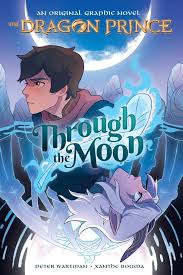
The Dragon Prince: Through the Moon
by Peter Wartman & Xanthe Bouma
Genre: Graphic Novel
Target Age Group: Grades 4-6 (Upper Elementary to Middle Grade)
Summary
Based on the hit Netflix series The Dragon Prince, this original graphic novel follows Rayla, Callum, and Ezran on a new adventure that bridges the gap between seasons 3 and 4 of the show. The trio sets out on a three-day quest involving the Moon Nexus, where Rayla seeks answers about her parents and Callum must confront loss, grief, and growing responsibility. Themes of love, mourning, and courage unfold against a richly illustrated fantasy world of elves, dragons, and humans.
Why I Chose This Book
I selected Through the Moon because of its accessibility for youth readers who love popular culture tie-ins. Many children are already familiar with The Dragon Prince from Netflix, and expanding that interest into a graphic novel provides an excellent pathway for recreational reading. For this project, I also needed to read one book digitally, and finding the right edition online was a challenge due to the sheer amount of Dragon Prince media. Ultimately, I chose this book because it bridges the gap between television storytelling and print, making it both popular and academically relevant for middle-grade readers.
Evaluation
- Visual Narrative and Artistic Appeal
As Children’s Literature, Briefly (Ch. 2 on literary forms) emphasizes, illustrations play a crucial role in meaning-making in children’s books. Xanthe Bouma’s art is bright, expressive, and kid-friendly, with a modern cartoon style that matches the show’s aesthetic. The visual transitions between soft, warm tones and darker, eerie palettes (such as page 11’s shift into shadows) signal emotional stakes and guide readers through complex moods. These visual cues make the story accessible even for those less familiar with the franchise.
2. Themes of Loss and Emotional Honesty
Following Children’s Literature, Briefly (Chapter 3 on content and theme), the book addresses profound topics such as grief, accountability, and the cycles of life and death. Rayla’s struggles with mourning, Callum’s goofy yet sincere love, and Ezran’s responsibilities as a young king all resonate with tween readers. Lines such as “White lies are illusions you build with your words to protect the hearts of those you love” demonstrate how the story weaves maturity into a fantasy setting. These lessons make the narrative both entertaining and meaningful for its age group.
3. Reader Response and Relatability
As noted in Children’s Literature, Briefly (Ch. 4 on response), youth readers engage most when they see themselves in characters’ struggles. Even though I was unfamiliar with The Dragon Prince beforehand, I found the characters, especially Rayla and Callum, instantly relatable. Rayla embodies the troubled yet courageous teen heroine, while Callum is portrayed as the awkward but caring himbo boyfriend. Their humor, fears, and awkward honesty mirror real adolescent experiences. This relatability helps readers connect emotionally, even if they don’t fully understand the franchise’s backstory.
Citation (APA 7th Edition)
Wartman, P., & Bouma, x. (Illus.). (2020). The dragon prince: Through the moon. Scholastic Inc.
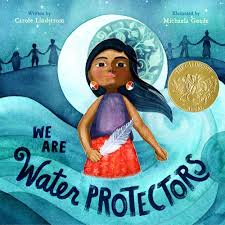
We Are Water Protectors
by Carole Lindstrom, illustrated by Michaela Goade
Genre: Caldecott Medal book
Target Age Group: PreK-6th Grade
Summary
We Are Water Protectors is a lyrical picture book inspired by Indigenous-led movements across North America, including the Standing Rock movement. Narrated by a young Ojibwe girl, the story honors the sacredness of water, weaving prophecy, spirituality, and ecological urgency into its pages. With vivid illustrations and poetic refrains, the book calls on readers of all ages to rise against the “black snake” (oil pipelines) and to stand united as protectors of the Earth.
Why I Chose This Book
I chose this Caldecott Medal winner because of its cultural importance and contemporary relevance. Water protection is not only an environmental concern but also a social justice issue, and this book bridges both in ways that are accessible for children. I also wanted to highlight an Indigenous author and illustrator (Carole Lindstrom and Michaela Goade), as representation in children’s literature remains an ongoing need. The inclusion of an Earth Steward and Water Protector pledge at the end of the book further emphasizes the participatory nature of the text, making it an ideal choice for classroom or library programming.
Evaluation
- Illustration as Meaning-Making
According to Children’s Literature, Briefly (Chapter 2 on literary forms), illustrations do more than support the text; they expand its meaning. Michaela Goade’s artwork layers cultural imagery with natural symbolism. The paper-doll-like textures and soft palettes evoke animation, while the flowing hair of the protagonist, depicted as a river teeming with life, visually conveys the interconnectedness of humans and ecosystems. The “black wsnake” illustrations, coiled like pipelines, make abstract threats tangible for young readers.
2. Themes of Culture and Environmental Responsibility
As Children’s Literature, Briefly (Ch. 3 on content and theme) stresses, children’s literature communicates cultural values and ethical frameworks. This book draws directly from Ojibwe culture and the Seven Fires Prophecy, positioning water as “the first medicine.” Its repeated poetic refrain, “We stand/ with our songs/ And our drums/ We are still here,” emphasizes resilience and continuity of Indigenous peoples. The environmental message is woven into spirituality, making ecological activism not just a political endeavor but also a sacred one.
3. Reader Response and Empowerment
Chapter 4 of Children’s Literature, Briefly highlights the role of response in children’s reading experiences. The book concludes with an “Earth Steward and Water Protector Pledge,” inviting readers to sign and date their commitment. This interactive element transforms the reading experience into personal activism, bridging story and lived responsibility. Children are not just passive recipients of a message, but are positioned as active change-makers, empowered to protect their communities and the world.
Citation (APA 7th Edition)
Lindstrom, C., & Goade, M. (Illus.). (2020). We are water protectors. Roaring Brook Press.
The Legend of Gravity: A Tall Basketball Tale
by Charly Palmer

Genre: Bluebonnet
Target Age Group: PreK-6th grade
Summary
Charly Palmer’s The Legend of Gravity tells the story of a lanky, knobby-kneed newcomer who strolls onto the blacktop court and astonishes everyone with his moves. Known as “Gravity,” this new kid jumps so high, dribbles so fast, and plays with such smoothness that he quickly becomes part of the block’s basketball lore. Narrated in a lively, storytelling style that appeals to kids on the block, the book blends neighborhood culture, tall tale exaggeration, and authentic basketball into an unforgettable debut.
Why I Chose This Book
I chose this book because it appeared on the Texas Bluebonnet Award list and has been widely praised for its painterly illustrations and cultural authenticity. As a debut author-illustrator project, it showcases both artistry and storytelling, and I was curious to see how Palmer would merge the traditions of oral tall tales with contemporary playground basketball culture. Its placement on a major award list confirmed its critical recognition and suitability for young readers.
Evaluation
- Illustration & Style
Palmer’s illustrations are bold, urban, and painterly, echoing the aesthetics of city street murals. The images vibrate with energy, perfectly capturing the centrifugal force of players in motion. Text and images flow together; the motion of the words almost dances across the page. The lineup spreads for both teams (Eagles vs. Flyers) read like a neighborhood mural come alive, complete with colorful nicknames that bring authenticity and fun.
2. Language & Voice
The narration feels like a grandpa, uncle, or “ol’ fella” holding court on the block, telling kids the story of “Gravity” and his legendary feats. This oral storytelling candence is both culturally resonant and accessible to young readers. Basketball vocabulary, “man-to-man coverage,” “triangle defense,” “fadeaway jumpers”, grounds the tall tale in the language of the sport, while metaphors like “dribbling faster with his mouth than with the ball” create humor and vivid characterizations.
3. Cultural Relevance & Engagement
The book excels at linking community, culture, and sport. From references to neighborhood courts and Sunday play after church, to imagery of waves “so tight they’d make you seasick,” the book celebrates Black urban culture with warmth and respect. The nicknames, Gravity, Liquid, Sky High, and Left2Right, are both playful and authentic to playground basketball traditions. The tall tale exaggeration (“he jumped so high we had time for ice cream before he came down”) invites laughter while building mythic resonance. Palmer’s debut is a slam dunk for classrooms, libraries, and read-aloud sessions. It celebrates culture, community, and imagination while engaging young readers with dynamic language and unforgettable visuals. This book not only entertains but also introduces children to storytelling traditions rooted in exaggeration, rhythm, and neighborhood pride.
Citation (APA 7th Edition)
Palmer, C. (2022). The legend of Gravity: A tall basketball tale. Farrar, Straus and Giroux.
One Last Word
by Nikki Grimes
Genre: Poetry
Target Age Group: PreK-6th grade
Summary
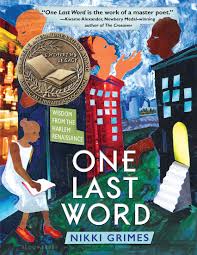
One Last Word: Wisdom from the Harlem Renaissance (2017) by Nikki Grimes is a poetry collection that bridges the voices of Harlem Renaissance poets with Grimes’s own modern reflections. Using the Golden Shovel poetic form, where each line ends with a word from an original poem. Grimes responds to classic works by poets such as Langston Hughes, Countee Cullen, and Georgia Douglas Johnson. The result is a conversation between generations, past and present, woven together by stunning mixed-media illustrations from multiple artists.
Why I Chose This Book
I chose this title because it provides a powerful and accessible introduction to poetry and Black literary history for young readers. Nikki Grimes’s ability to connect 20th-century art with modern identity and resilience makes this book a bridge between classrooms, cultures, and generations. It also introduces the Golden Shovel form, a creative structure that invites students to write their own poetry in response to history. The book’s mix of art, language, and rhythm fits perfectly for visual and emotional learners in the PreK-6th range, while still offering sophistication for older readers.
Evaluation
- Poetic Form & Literary Craft
Grimes’s use of the Golden Shovel form demonstrates both reverence and innovation. By placing historic lines at the heart of her poems, she creates a dialogue with the past that feels living and breathing. Each poem becomes a mirror. Reflecting the poet’s respect for the Harlem Renaissance while reframing its themes of perseverance, beauty, and identity through a contemporary lens.
2. Artistic Collaboration
The illustrations by renowned artists such as Cozbi A. Cabrera, Brian Pinkney, and Javaka Steptoe elevate the collection into a multimedia experience. Their painterly and collage-inspired styles complement Grimes’s verse, offering visual metaphors for the duality of the poems: history and now, tradition and transformation. This book becomes as much an art piece as a literary one.
3. Cultural & Educational Significance
This collection serves as a gateway into both African American history and poetic analysis. For young readers, One Last Word teaches how poetry can be personal, political, and creative all at once. The historical context provided in the back matter enhances comprehension, making it an ideal resource for the classroom. Grimes’s voice embodies empathy, strength, and mentorship —qualities that resonate deeply with youth navigating identity and heritage in today’s world.
Citation (APA 7th Edition)
Grimes, N. (2017). One last word: Wisdom from the Harlem Renaissance. Bloomsbury Children’s Books.
Witchlings
by Claribel A. Ortega

Genre: LGBTQ+
Target Age Group: PreK-6th grade (4th-6th)
Summary
In Witchlings (2022), Claribel A. Ortega invites readers into the whimsical yet socially complex world of Twelve Towns, where young witches are sorted into covens during the sacred Black Moon Ceremony. When twelve-year-old Seven Salazar ends up a “Spare,” a witch without a coven, she must team up with two other Spares to complete the impossible Nightbeast Trial or risk losing their magic forever. With humor, heart, and a touch of danger, Ortega spins a story about friendship, courage, and belonging.
Why I Chose This Book
I chose Witchlings because it beautifully represents inclusive middle-grade fantasy that blends classic magical tropes with modern sensibilities. Ortega’s Dominican heritage and her focus on identity, belonging, and community make this a strong choice for the classroom and library for diverse readers. The book also promotes representation in fantasy, a genre where many children of color and LGBTQ+ youth have historically been underrepresented. The whimsical cover design and accessible writing style invite younger readers while still offering emotional depth and layered world-building.
Evaluation
- World-Building & Style
The Twelve Towns universe is richly imagined, filled with colorful covens, clever magical systems, and everyday witching details (like toad races and enchanted amulets). Ortega’s style is both vivid and cinematic, filled with modern language and cultural references that ground the fantasy world in a relatable tone. Her inclusion of elements like social hierarchy, class division (Hill Witches vs. Spares), and community rituals encourages critical thinking about social equity and systems of belonging among young readers.
2. Characterization
Seven Salazar, the protagonist, is an immediately sympathetic character, ambitious, flawed, and deeply human despite her magical setting. The supporting cast, including Poppy and Thorn, adds both comic relief and emotional resonance. Ortega excels at portraying the dynamics of friendship and emotional growth, emphasizing collaboration over competition. This is particularly significant for young readers navigating identity and peer relationships.
3. Themes & Educational Value
At its core, Witchlings is about inclusion and identity. The “Spare” label serves as a metaphor for all forms of exclusion children face, economic, social, racial, or personal. Ortega employs fantasy to render these heavy themes more accessible, fostering empathy and resilience. The book also models problem-solving and collective action in the face of systematic bias, aligning with social-emotional learning goals. While some plot elements are predictable, the heart and humor more than make up for it.
Citation (APA 7th Edition)
Ortega, C. A. (2022). Witchlings. Scholastic Press.
Frizzy
by Claribel A. Ortega, illustrated by Rose Bousamra
Genre: Pura Belpre Winner
Target Age Group: PreK-6th grade (4th-6th)
Summary
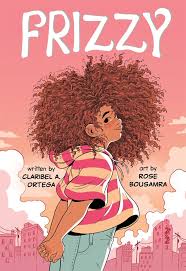
In Frizzy (2022), middle schooler Marlene struggles with self-acceptance as she navigates her Dominican family’s expectations of beauty. Every Sunday, she endures salon visits to straighten her curly hair, but inside, she longs to embrace her natural curls and the freedom they represent. With support from her tia Ruby and her best friend, Marlene learns to love herself and her hair for what it truly is: a reflection of her identity and culture.
Why I Chose This Book
I chose Frizzy because it’s an exceptional graphic novel about self-image, culture, and self-love, particularly for young readers of color. Ortega’s storytelling and Bousamara’s expressive art create a vibrant, accessible, and affirming narrative that connects emotional growth with cultural pride. Winning the 2023 Pura Belpré Award, this book represents authentic Latinx voices and centers on natural Black and Afro-Latinx hair, a vital yet often overlooked topic in youth literature. The story’s visual style and voice make it ideal for reluctant readers or those transitioning from picture books to novels.
Evaluation
- Artistic Style & Visual Storytelling
Rose Bousamara’s illustrations are warm, expressive, and full of movement. The visual storytelling perfectly complements Ortega’s emotional narrative. The art reflects Marlene’s journey from shame to pride through clever color transitions, gray tones in salon scenes shift into rich, full hues as Marlene gains confidence. This aligns beautifully with concepts from Children’s Literature, Briefly (Ch. 2), where the interplay of text and image deepens reader engagement and emotional understanding.
2. Cultural Representation
Frizzy provides a joyful, authentic look into Dominican and Afro-Latinx identity, challenging Eurocentric beauty standards while celebrating natural hair. Ortega handles this with nuance and warmth, never lecturing, always inviting. Themes of intergenerational understanding, especially between Marlene and her mother, mirror many young readers’ lived experiences, encouraging conversations about cultural pride, individuality, and respect.
3. Characterization & Themes
Marlene is a perfectly crafted protagonist: relatable, funny, insecure, and ultimately powerful. Her journey toward self-acceptance models emotional intelligence and resilience. Ortega’s dialogue is natural and current, filled with gentle humor and heartfelt moments. The book’s focus on self-expression, family bonds, and community support aligns with Children’s Literature, Briefly (Ch. 3 and 4) discussions on social identity formation and empowerment in middle-grade narratives.
Citation (APA 7th Edition)
Ortega, C. A., & Bousamara, R. (2022). Frizzy. First Second Books.
Child of the Dream: A Memoir of 1963
by Sharon Robinson
Genre: Biography
Target Age Group: PreK-6th grade (4th-6th)
Summary
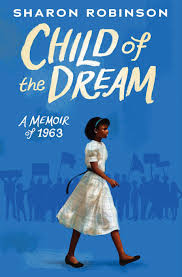
In Child of the Dream: A Memoir of 1963 (2019), Sharon Robinson, daughter of baseball legend Jackie Robinson, shares her experience growing up during one of the most turbulent and transformative years in American history. At 13 years old, Sharon witnesses the Civil Rights Movement unfolding around her as she discovers her own voice and values. Through personal stories, photographs, and historical context, she connects her family’s legacy to the broader fight for racial equality, weaving history with intimate reflection.
Why I Chose This Book
I selected Child of the Dream because it serves as both an engaging coming-of-age story and a powerful introduction to civil rights history for young readers. Robinson’s memoir offers a firsthand account of the emotional and social realities of growing up Black in 1960s America, written with honesty, clarity, and hope. The inclusion of real photographs, especially those thoughtfully placed at the book’s midpoint, adds authenticity and visual grounding, inviting readers to see history as a lived experience rather than a distant fact.
Evaluation
- Narrative & Literary Craft
Robinson’s writing is both lyrical and direct, capturing the emotional pulse of adolescence and historical change. She writes with warmth and introspection, blending journal-like reflection with moments of sharp historical insight. Her perspective, as the daughter of a national icon, provides a unique lens into the era, balancing the public and personal aspects beautifully.
2. Historical & Visual Elements
The black-and-white photographs scattered throughout, and especially the section in the center, anchor the text in realism. These visual elements invite young readers to pause and reflect on the real people and events behind Robinson’s story. They also break up the longer narrative, making the text more approachable for children transitioning into longer chapter books or nonfiction works.
3. Cultural & Educational Value
Child of the Dream encourages readers to view activism as both a historical and personal endeavor. It underscores themes of courage, family, justice, and self-discovery while affirming that young voices matter in social movements. The text complements classroom units on civil rights or American history, promoting empathy and critical thinking about equity and community responsibility.
Citation (APA 7th Edition)
Robinson, S. (2019).Child of the Dream: A Memoir of 1963. Scholastic Press.
Hummingbird
by Natalie Lloyd
Genre: Disability or differences
Target Age Group: PreK-6th grade (4th-6th)
Summary
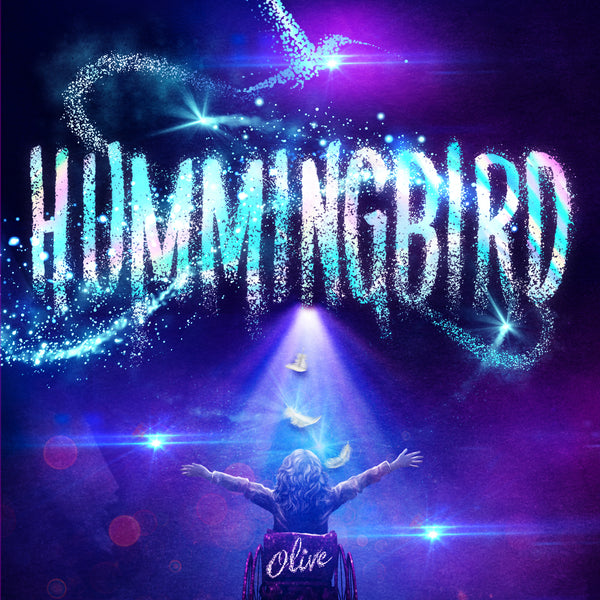
Hummingbird follows Olive Miracle Davis, a twelve-year-old girl with brittle bone disease (OI). After years of being homeschooled for safety, Olive desperately wants to try public school, just once, to have real friends and real experiences outside her front door. She is optimistic, funny, and stubborn in the best way, and her voice carries the whole book. With help from her magical-realistic family legacy (the “Miracle” line), Olive learns friendship, bravery, and what it means to belong in a world that wasn’t built with her body in mind.
Why I Chose This Book
I chose Hummingbird for my disability/differences selection because it handles chronic physical disability with honesty, emotional depth, and joy. Olive’s story isn’t tragedy-centered; it’s about agency. Kids with disabilities deserve books where the main character gets to be bold, funny, stubborn, magical, and loud. And Natalie Lloyd delivers that beautifully. It also fits perfectly for upper elementary readers: accessible writing, short chapters, and strong character-driven emotion. And honestly, Olive is just lovable. She’s the kind of protagonist students root for immediately.
Evaluation
- Disability Representation
Natalie Lloyd herself has OI, and you can feel the authenticity in every scene. Olive’s bones break easily, but the story never reduces her to “fragile.” Instead, she is capable, clever, and fully human. The book strikes a balance: it acknowledges real barriers(stairs, bullies, overprotection, pain) but also celebrates Olive’s independence and dreams. For the disability/differences requirement, this book is ideal. It shows disability as a part of identity, not the whole story..
2. Themes of Belonging & Courage
The novel centers on belonging: Olive wants to be treated like a regular kid while still honoring the realities of her condition. Her desire to make a friend, join a club, or simply be included hits hard. Courage in this story is not about overcoming disability. It’s about navigating a world that isn’t built with you in mind and still choosing joy. That message is developmentally appropriate for elementary readers learning empathy.
3. Magical Realism Tone
The light magical elements (the “Miracle” gift, the hummingbird symbolism) create a gentle fantasy layer that softens some of the heavier themes. It almost feels like a warm blanket. This makes difficult topics, not fitting in, medical fears, loneliness, more approachable and kid-friendly.
Citation (APA 7th Edition)
Lloyd, N. (2022).Hummingbird. Scholastic Press.
Brown Girl Dreaming
by Jacqueline Woodson

Genre: Coretta Scott King Winner (2015)
Target Age Group: PreK-6th grade (4th-6th)
Summary
In Brown Girl Dreaming, Jacqueline Woodson tells the story of her childhood through beautifully crafted poems. She moves between Ohio, South Carolina, and Brooklyn as she tries to figure out who she is and where she belongs. The book is both personal and historical. Touching on family, faith, the Civil Rights Movement, and her early pull toward storytelling. It’s gentle, lyrical, and full of emotion in a way that is deeply accessible to upper-elementary readers..
Why I Chose This Book
I chose Brown Girl Dreaming because it remains one of the most important children’s memoirs of the last decade and because it represents the heart of the Coretta Scott King Award criteria, celebrating Black experiences with honesty, depth, and pride. The short poems make it less intimidating for developing readers, and the visuals created by Woodson’s language invite kids to sit inside her memories. This is a book that teaches history through lived experience, which is so important for young readers who may only understand the Civil Rights Movement in textbook terms.
Evaluation
- Literary Craft: Poetry as Storytelling
Woodson’s verse is incredibly intentional and simple enough for young readers to follow, but layered with meaning for older ones. The book becomes an invitation into her childhood memories. The poetic structure also gives students room to pause, reflect, and breathe between moments.
2. Cultural & Historical Value
Because this memoir traces Woodson’s life across the height of the Civil Rights era, students get a child’s-eye view of history. Moving through segregated spaces in the South. The tension and change of the era. The family’s move North and what that meant. Identity shaped by place and community. These moments are powerful but not overwhelming. They’re handled with a softness that still respects the truth.
3. Identity, Family, and Growing Up
Woodson explores what it means to grow up between different places, different expectations, and different versions of herself. Her family, especially the women who raised her, is central, making this a rich read for kids learning about family identity and self-expression.
Citation (APA 7th Edition)
Woodson, J. (2014).Brown Girl Dreaming. Nancy Paulsen Books.
Bear’s Lost Glasses
by Leo Timmers
Genre: Texas 2×2
Target Age Group: PreK-6th grade (PreK-2)
Summary
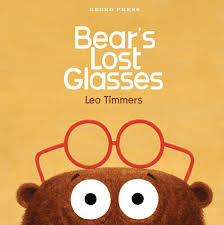
Bear’s Lost Glasses follows a sweet, slightly clueless bear who wakes up without his glasses and begins confusing everything he sees. Every animal he meets gets mistaken for something completely different, leading to a string of very funny misunderstandings. Kids get to enjoy the pattern, humor, and surprise as Bear tries to make sense of the world around him.
Why I Chose This Book
I chose Bear’s Lost Glasses because the Texas 2×2 list is all about books that are fun, engaging, and developmentally perfect for young readers. And this one nails that mission. It’s simple, silly, and interactive in a way that really supports early literacy. This is also a great read-aloud book for storytime, whether at a public library, in a classroom, or in an early childhood setting. The humor is gentle and visual, which makes it especially accessible to pre-readers and emerging readers. Picture books like this remind me that reading is joyful and that books can make them laugh.
Evaluation
- Visual Literacy & Illustration Style
Leo Timmers is known for bold, colorful, high-contrast art, and this book is a perfect example. The illustrations carry much of the storytelling. Kids can “read” the pictures even if they can’t decode the words yet. Every page gives them something to predict, notice, or question. For young children learning to track visual details or identify objects, this book naturally strengthens those skills.
2. Humor, Pattern, and Predictability
The repetitive structure, Bear misidentifying each animal, sets up a rhythm that encourages participation. Kids start guessing what Bear thinks he’s seeing and what the animal really is. Predictable patterns like this are excellent for building confidence in emerging readers and supporting comprehension.
3. SEL & Developmental Value
Even though the book is mostly silly, it gently reinforces important early-childhood themes: learning from mistakes, asking for help, noticing differences, and perspective-taking. Bear’s confusion isn’t framed as something to be embarrassed about. It’s part of the fun. This makes it a safe, lighthearted text for children who may struggle with sight, attention, or detail orientation themselves.
Citation (APA 7th Edition)
Timmers, L. (2023).Bear’s Lost Glasses. Clarion Books.
 JustLj.com